

Part Two: Empowerment Through Therapy
Rebuilding what has been torn down inside.
Story By: Tiffany White
Trauma is a part of every foster child’s life, but they don’t have to succumb to it. Skylar Gilmore, an onsite therapist at St. Joe’s who counsels the teenage boys in Cottage A, starts with the basics: establishing trust and teaching them self-control. “When I meet them for the first time, the first couple of sessions focus on building relationships and getting to know them. But after we get past that stage, I focus on their treatment goals. A lot of the time I’ll ask how they’re doing. They’ll start talking about something that happened, and we process that,” she says. If the child responded negatively in the situation, Skylar talks with him about ways he could have handled the conflict differently.
Because each child is different, the residential therapists offer varying types of therapy for them. Play therapy, she says, is particularly popular among the boys, since many of them enjoy sports, while others simply like walking during their session. “Me and one of the kids will go outside, and we’ll talk while we’re passing a soccer ball back-and-forth.” Science shows that physical activity is beneficial for mental health, and St. Joe’s in collaboration with Hollenbach-Oakley LLC, Booker Design Collective, JRA Architects, and E-Z Construction Co., are working on plans for SJ@Play, a Play and Wellness Complex for our children in residential. Some of the features include a pavilion, splash pad, walking trail, and amphitheater.
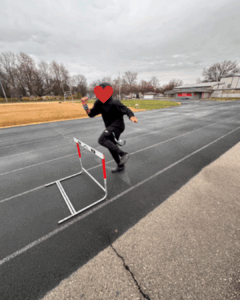
“I feel like my health and body is cared for by St. Joe’s. Some of our cottage supervisors have us do exercises such as relays, YouTube workouts, and running. Exercising and eating healthy help us to feel strong and have a positive body image,” says one of our SJ kids.
As an art therapist, Skylar also utilizes expressive therapies like sand tray therapy, a type of therapy that gives the child some distance with processing trauma or their emotions. “They are doing some sort of intervention or a prompt that’s given by the therapist and creating it in an environment that isn’t as intimidating as talk therapy would be. It gives them something else to focus on.”
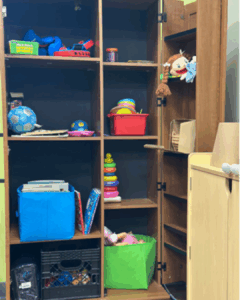
“We go to therapy, and it can be really hard to talk about what we are feeling and going through. While we are in talk therapy, we play with toys and fidgets. We get to talk through our problems while building healthy coping skills.”
Children are given a box of sand along with miniatures such as cars, people, and fences. They select the objects they want to use based on a prompt. “I might say, ‘Create your world. Or create a depiction of boundaries. What does that look like?’” “And then it’s the therapist’s job to keep them focused on the sand tray by helping them realize how they relate to it, because trauma and creativity are stored on the same side of the brain.”
Skylar recalls a positive outcome from a session with one of her kids using sand therapy: “I had one kid who was really struggling with peer conflicts, and to avoid it, he was isolating in this room. He depicted that in the tray by picking military men who were fighting and then he shows figures hiding behind the fence.” Through processing the scene, he was able to recognize his own behavior and work on addressing it. Whenever a child has what Sylar refers to as a “baby win,” it is a huge victory for them, because they are constantly wrestling with the impact of trauma. “You’re not seeing growth immediately. It’s a very long, drawn out process … we’re planting seeds. I always tell social workers: ‘I’m not expecting perfection on treatment goals. I’m expecting progress.”
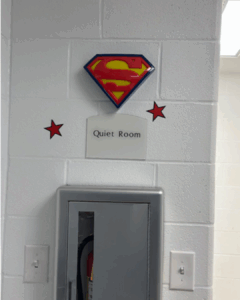
“This represents a space for us to get away when we are mad and can’t cope with our sadness and anger. It’s a place to self-regulate and calm down. There are a lot of emotions in a residential center and it’s important to have a room like this.”
In Part Three of “A Day in the Life of a SJ Kid,” take you through the typical routine of our residential kids. Follow us on our social channels to read the story and subscribe to SJ Stories, our blog, to automatically receive each installment in your inbox.
ICYMI: Read Part One of “A Day in the Life of a SJ Kid.”
This post was supported by funds made available by the Kentucky Department for Public Health’s Office of Health Equity from the Centers for Disease Control and Prevention, National Center for STLT Public Health Infrastructure and Workforce, under RFA-OT21-2103. The content of this post are those of the authors and do not necessarily represent the official position of or endorsement by the Kentucky Department for Public Health or the Centers for Disease Control and Prevention.