For most teenagers, “home” is a given. But for Janie and Rachel — two of our residents at St. Joe’s — home has meant moves, uncertainty, and families “on pause.”
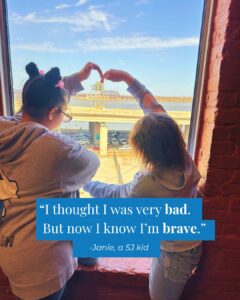
For most teenagers, “home” is a given.
But for Janie and Rachel — two of our residents at St. Joe’s — home has meant moves, uncertainty, and families “on pause.” Janie remembers fighting often, and neither of them believed anyone understood their pain. The smell of cigarette smoke is triggering for Rachel, because it brings back memories she’d rather forget. These are not “bad kids.” They are kids who have been through more than most of us can imagine.
They arrived here as strangers over a year ago. Now, they talk about each other like sisters. They argue, make up the next day, and they are learning—often for the first time—what it feels like to belong somewhere and to someone. “‘We have the same hair and almost the same personality. ‘We’re basically sisters,’ says Janie. “‘But we just don’t know it,’” says Rachel, laughing in agreement.
Here, with consistent therapists, teachers, and staff, they are learning new ways of coping: walks instead of outbursts, art instead of shutting down, talking instead of fighting. They’ve started to dream about becoming a teacher, a nurse, a beautician, a vet—and about one day having a stable, loving home of their own.
Your gift makes this possible. It funds the trauma‑informed counseling, on‑site education, and 24/7 care that help children in state custody move from temporary beds and short‑term fixes toward the safety and stability of a true forever home—wherever that may ultimately be. Please give as generously as you can, so our SJ kids aren’t left behind.
Update: We’re happy to share that Janie and Rachel are now with loving families — thanks to your support. Stories like theirs happen because of you. Every donation helps shape the future success of our SJ kids. Give today and change a child’s life.
*Names have been changed to protect privacy.
This post was supported by funds made available by the Kentucky Department for Public Health’s Office of Health Equity from the Centers for Disease Control and Prevention, National Center for STLT Public Health Infrastructure and Workforce, under RFA-OT21-2103. The content of this post are those of the authors and do not necessarily represent the official position of or endorsement by the Kentucky Department for Public Health or the Centers for Disease Control and Prevention.